What to expect
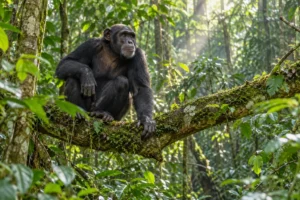
Kibale National Park is one of Uganda’s best-known places for seeing chimpanzees in a natural forest setting. The park lies in western Uganda, within reach of Fort Portal, and protects a landscape of tall forest, smaller clearings and varied wildlife. Travellers often visit for a guided chimpanzee-tracking walk, but birdwatching, forest scenery and nearby community experiences can make a stay worthwhile even if primates are your main interest.
About Kibale National Park
The first thing to understand about Kibale is that it is a protected forest, not an open savannah park. You explore it on organised activities with authorised guides rather than by driving independently in search of animals. Chimpanzees are the main attraction, although the park is also important for other primates, birds and forest plants. The experience changes with the weather, fruiting trees and the movement of the animals.
The Kanyanchu area is a major starting point for visitor activities. Your lodge may be close to the forest or farther towards Fort Portal, so check your morning travel time before booking. It is easier to enjoy an early activity when you are not rushing from a distant property. If you want several forest experiences, staying at least two nights gives you a more comfortable schedule.
Location at a glance
Kibale is in Uganda’s Western Region. The coordinates below identify the approximate mapped area rather than a particular visitor entrance. Use the confirmed activity meeting point, not these coordinates, when arranging your transfer.
| Place | Kibale National Park |
|---|---|
| Country | Uganda |
| Type | Park |
| Area | Western Region |
| Latitude | 0.50000 |
| Longitude | 30.40000 |
Planning a visit to Kibale National Park
Start by deciding whether chimpanzee tracking is essential to your trip. If it is, ask your operator to check permit availability before you commit to non-refundable accommodation or flights. Uganda Wildlife Authority manages the park’s official tracking activities, and arrangements may change. Your booking confirmation should state the date, meeting point, required identification and what you must bring.
The tracking walk begins with a briefing and continues through the forest in search of the chimpanzees. You might hear calls in the trees before seeing the animals. Some days involve steady walking, while others require more time on uneven, muddy ground. A sighting is never guaranteed, and you should not expect the same route or length of walk as another visitor.
Normal chimpanzee tracking and the longer habituation experience are different products. The habituation experience is intended for visitors who want to spend more time observing the animals with the appropriate team. It generally requires a much earlier start and a stronger willingness to walk. Ask which activity you are buying rather than relying on the broad phrase ‘chimpanzee experience’.
Nearby named places
The surrounding countryside has crater lakes, farmland, forest-edge communities and small accommodation centres. The original place record for this guide lists the nearby lakes below. These are approximate straight-line distances from a mapped reference point, not driving distances or guarantees of public access. Some lake roads are winding, and a lake that looks close on a map may take longer to reach than expected.
| Nearby place | Approximate distance |
|---|---|
| Lake Nyinabulita | 8.6 km straight-line |
| Lake Nyamirima | 9.3 km straight-line |
| Lake Nkuruba | 10.9 km straight-line |
| Lake Nyanswiga | 12.5 km straight-line |
Bigodi Wetland Sanctuary is another familiar addition to a Kibale visit. Its guided community walks can offer a different view of the forest-edge environment, with opportunities to look for birds and smaller wildlife. Confirm the current meeting place, fees and walking conditions directly with your organiser. Bigodi works well as an afternoon activity after a morning forest visit, provided you are not too tired.
Travel timing and practical arrangements
Many visitors reach Kibale by road via Fort Portal. The journey from Kampala or Entebbe is a substantial transfer, so it is sensible to arrive the day before a morning chimpanzee activity. A driver-guide can help you plan breaks, but traffic and roadworks can change arrival times. Do not schedule a tracking permit on the assumption that a long same-day transfer will go perfectly.
Wear closed walking shoes with a good grip, long trousers and a light waterproof layer. The forest can be humid even when the morning starts cool, and rain may arrive without much warning. Carry water in a small day bag, but follow the guide’s instructions about food and drink near primates. Keep a little space in your schedule afterwards to rest and clean muddy shoes rather than rushing to another distant park.
If you travel with children, check the current minimum age for the specific tracking product before booking. A family travelling with younger children may need a split programme, where some adults track chimpanzees and others enjoy an age-appropriate activity. Accessibility is also important: forest paths are not smooth paved walkways, and the distance needed to find the chimpanzees can vary considerably.
Responsible travel
Chimpanzees are wild animals and are vulnerable to human disturbance and illness. Follow the official briefing, keep the distance required by your guide and avoid flash photography. Never try to attract an animal’s attention or move closer for a better photograph. If you feel unwell, inform the organiser before entering the forest. Protecting the chimpanzees takes priority over completing an activity you have booked.
There is value in staying longer in the area rather than rushing through it. You can use local guides for appropriate walks, eat at locally operated places and ask about community initiatives that welcome visitors. Avoid assuming every village or farm is open for tours. Permission and a fair agreement with the hosts should come before a visit or photographs.
Frequently asked questions
Where is Kibale National Park?
It is in western Uganda, near the Fort Portal area. Your actual travel destination will usually be a lodge or an official activity meeting point such as Kanyanchu. Ask for that precise location when planning transport, since the park covers a much wider forest area than a single map pin.
Is Kibale National Park a tourism destination?
Yes. It is an established protected area where Uganda Wildlife Authority offers organised chimpanzee experiences and other visitor activities. Advance planning matters, particularly for restricted tracking places. You should confirm the available programme for your dates before choosing a lodge.
Can I combine Kibale National Park with other places?
Yes. Queen Elizabeth National Park is a common next stop for travellers who want to combine primate tracking with savannah game drives and a boat journey on the Kazinga Channel. Some itineraries also include the Fort Portal crater lakes. Allow enough days for driving and avoid stacking too many activities on one morning.
What should I check before travelling?
Confirm your chimpanzee permit, activity meeting time, lodge location, transport plan and current park instructions. Ask about the physical demands of the walk, especially if you have knee or mobility concerns. A clear list of included fees is helpful because tracking, accommodation, transport and community activities are not necessarily sold together.
Build an informed itinerary
For most visitors, the strongest Kibale itinerary begins with an overnight arrival, a dedicated morning for chimpanzee tracking and some free time to enjoy the forest landscape. Add Bigodi or a crater-lake visit if the schedule allows. Tell your safari organiser your travel dates, walking ability and interests so the programme can be built around genuine availability rather than a crowded list of promises.